Legislative summary
Ontario Legislature returned with a new mandate, passing a flurry of controversial bills
April 15, 2025 marked the beginning of Ontario’s 44th legislative session. During the throne speech, the province outlined its priorities for the coming years, focusing primarily on economic policy in response to the ongoing trade tensions with the United States.
In this document, please find ONN’s analysis of legislation that have cross-cutting impact on Ontario’s nonprofit sector and/or connect to ONN’s public policy agenda. Nonprofits are encouraged to use this resource in their advocacy work and communications with government.
Subscribe to ONN’s mailing list to stay up to date on sector relevant public policy.
Provincial budget
Budget 2026 analysis: Another unsurprising budget for community organizations
In the legislature’s first week back from a long winter break, the Ontario Minister of Finance tabled the 2026/2027 Plan to Protect Ontario Budget as the first order of business.
Given the state of nonprofits and the communities we serve, nothing sticks out as transformative or responsive in this year’s budget. Revenues are projected to grow slightly and so spending is mildly increasing while $1.5 billion is being parked in a reserve fund. There are a couple of wins for few in the sector, while most are left grappling with ongoing uncertainty.
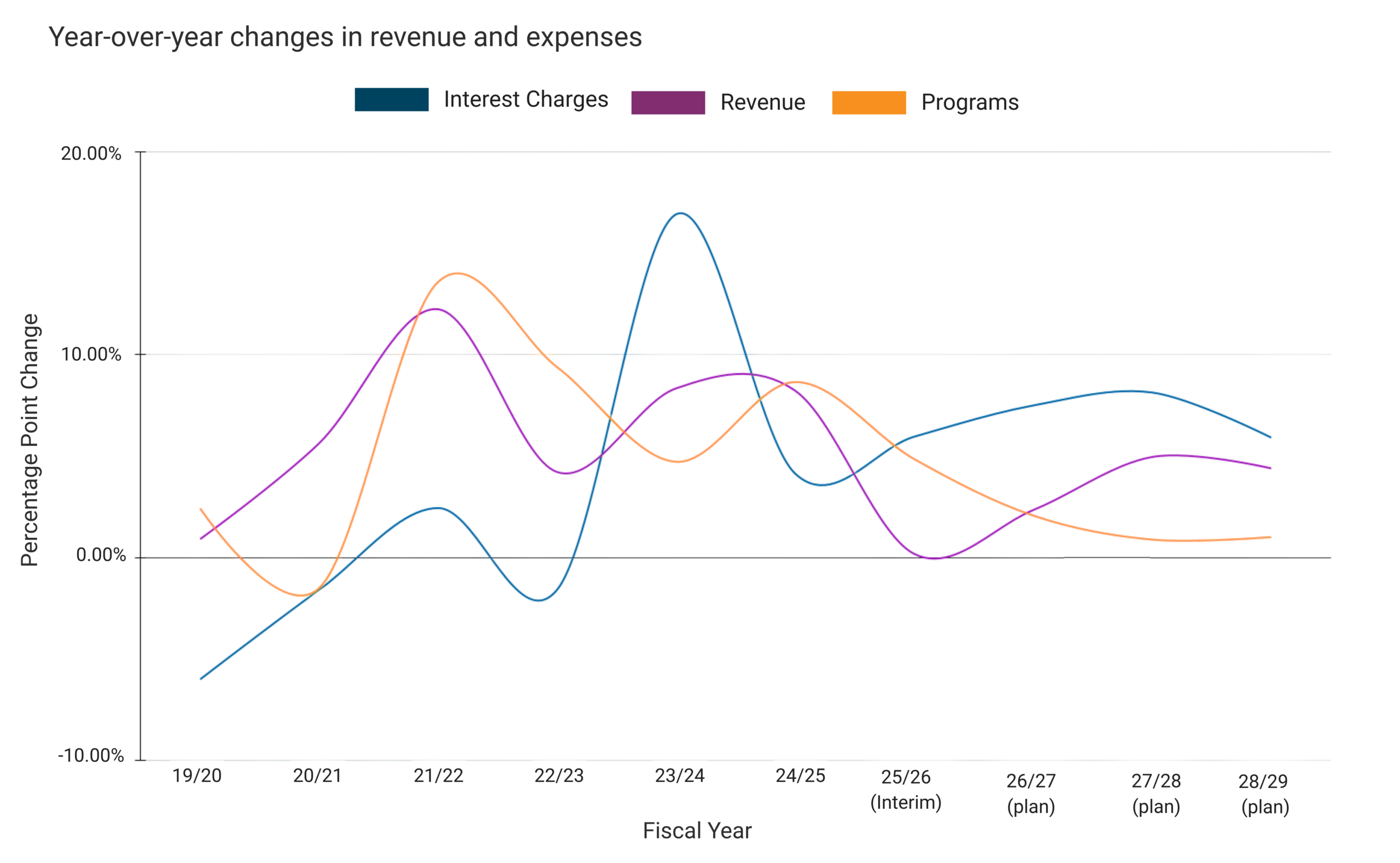
Compared to last year, the province is planning for:
- $231.9 billion in revenues (+2.34 percentage points)
- $227 billion in program spending (+2.7 percentage points) and $17.2 billion in debt servicing charges (+7.5 percentage points) for a total of $244 billion in expenses (+2.4 percentage points)
- $1.5B will be parked in a reserve fund (+200 percentage points)
- $13.8B deficit (+12.2 percentage points)
When digging into the ministry expenditures:
- Children, Community and Social Services total budget to stay the same
- Health base budget to +3 percentage points
- Labour, Training and Skills Development base budget -16 percentage points
- Tourism, Culture and Gaming base base budget +17 percentage points
- Sport base budget to stay the same
- Education base budget to +1 percentage point
- Attorney General base budget to +0.1 percentage point
- Seniors and Accessibility base budget to +1.1 percentage point
Thank you to all the nonprofits that advocated during the pre-budget cycle, the few wins reflected in the budget are due to your efforts. The advocacy does not stop here.
Wins for the nonprofit sector in Budget 2026
- $1.1 billion, over three years, for home and community care.
- $407 million, over three years, for community organizations serving people with special needs and developmental disabilities and survivors of gender-based violence or human trafficking to manage rising operational costs.
- $300 million, over six years, for the Community Sport and Recreation Infrastructure Fund to repair, upgrade or construct new sport and recreation facilities.
- $186 million, this year, to the Ontario Autism Program.
- $53 million, over three years, to expand supportive housing initiatives.
Ontario lobbying rules
Ontario lobbying rules apply to nonprofits who communicate with public office holders to influence directly or indirectly about a regulated matter. If your organization is volunteer led and run, the Ontario’s Lobbyist Registration Act (LRA) does not apply to you. Lobbyists are defined as paid staff.
The definition of lobbying is activities intended to influence a public office holder with respect to changes to legislation, regulations, programs, privatization, and awarding of grants, contributions or financial benefits.
The following activities do not count as lobbying under the LRA:
- Submissions made with respect to the enforcement, interpretation, or application of any act, policy, program, directive, or guideline.
- Submissions to legislative committees that are a matter of public record.
- Responses to written requests for information, advice or comment from a public office holder.
- Routine constituency communications that are a matter of private interest.
Registration is required when an employee(s) and/or paid director(s) individually or collectively spend at least 50 hours in a 12-month period lobbying on behalf of the nonprofit (that’s less than an hour a week).
Registering at the provincial level is not related to federal or municipal lobbyist registrations. Separate lobbying rules apply during elections.
- A Guide to the Lobbyists Registration Act 2026
- Interpretation Bulletins
- The Registration Process
- Nonprofit Advocacy Quiz
- Low-barrier nonprofit advocacy
- ONN’s briefing note and issues paper that outlines what you need to know about the Ontario Lobbyists Registration Act when the last significant update happened in 2016.
Public consultations
Public consultations are an opportunity for organizations to weigh in on government decisions. Submissions are a way to document dissent, concerns, queries, and provide alternative solutions. They can happen at any phase of the decision making process (identify priorities and issues, give feedback on draft policies and plans, and help develop a solution to a problem).
They can happen on the Government of Ontario website, in person through town halls, expert advisory groups, limited stakeholder engagements, or through the Regulatory Registry, Long-term Care Licensing Registry, or Environmental Registry.
Fall economic statements
Fall economic statements provide an update on the economic and financial outlook of the provincial government, since tabling its budget for the year. The statement often signals government priorities via the narrative, numbers, and budget and/or policy announcements in the statement.
The plan to protect is unclear
On November 6, Ontario’s Finance Minister delivered the province’s fall economic statement – an outlook based on the past six months of the fiscal year. The province is projecting a deficit of $1.1 billion, nearly $5 billion lower than the outlook published in the 2025 budget. While hot on the heels of the federal budget, the province notes its outlook does not consider the federal budget.
The statement restates many of its “Plans to Protect Ontario” already announced in Budget 2025 and over the summer: investments for manufacturing, steel, construction, and energy as the traditional pathways to bolstering and protecting Ontario’s economy during uncertain economic times. The nonprofit sector, despite being a key player in supporting and bolstering Ontario’s economy, seems to remain a low priority in the economic statement. Investments into the nonprofit sector, similar to those recently seen for the energy and manufacturing industry, would also function to protect jobs and Ontario’s economy.
The fall economic statement tees up Budget 2026 consultations in the coming weeks. ONN’s budget submission will reinforce key messages and recommendations from its 2025 State of the Sector report. We’ll be sharing our submission in early December.
Survey report recommendations:
- Create a home in government for nonprofits and charities to protect Ontario:
- Appoint an Associate Minister within the Ministry of Economic Development, Job Creation and Trade, supported by a Deputy or Assistant Deputy Minister in an Office representing nonprofits, charities, and social innovation.
- Ensure nonprofits are part and parcel of plans to Protect Ontario:
- Over $40 billion in new investments, loans, and other financial supports will be made available to mitigate impacts of the U.S. tariffs on communities which nonprofits must have targeted access to.
- Future-proof Ontarians’ social infrastructure:
- Deliver ministry budgets that reflect the true cost of delivering services and programs, keep pace with inflation, wages, demand, population shifts, and respond to emerging needs.
Dive into sector reactions
Pre-budget consultations
Pre-budget consultations are a valuable opportunity for nonprofits to amplify key issues and propose solutions for government action that impact their organizations, the broader sector, and the communities they serve. Particularly after an election cycle, it is important for the sector to use pre-budget consultations as a way to influence the new government at the outset of their mandate. The best budget submissions focus on clear and specific policy changes and commitments the government can make within a budget cycle.
Many ways to participate
There are many ways to participate, organizations do not have to do everything, but rather strategically select a way that best meets their needs and capacity:
- Fill out the budget survey or send a written submission to the Ministry of Finance.
- Email to inquire if you can join local consultations held by the Minister of Finance/Parliamentary Assistant.
- Apply to testify at a pre-budget hearing through the Standing Committee on Finance and Economic Affairs. There is a deadline to apply to testify.
- Amplify sector priorities and key messages in your submission or oral presentation and conversations with local MPPs.
- Endorse a network’s submission or copy and paste from submissions from organizations you work alongside.
- Bring attention to your pre-budget submission by sharing it with your community through social media, your newsletter, and at online or in-person events.
- Share your submission with us so we can amplify it and use it in our advocacy work! Email your submission to admin@theonn.ca.
Deadlines for 2027 budget
Pre-budget consultations typically take place in the fall. This section will be updated when dates are released.
Elections
The 2025 Ontario snap election was held on February 27, 2025. Premier Doug Ford was re-elected for a third majority government, and the NDP retained their status as the official Opposition while the Liberal Party gained official party status in the legislature.
During the snap election, many nonprofits showed up to call attention to the issues impacting them and the communities they serve and to engage communities to get out and vote. ONN put together many resources for nonprofits, analyzed policy platforms, and documented sector advocacy efforts.
Post election advocacy
There are a wide array of opportunities to continue to advocate for change and build a stronger network for collective action:
- Write to your newly elected officials, including new cabinet ministers and parliamentary assistants, congratulate them for being elected and express your interest in working with them in their critical roles. This is a great opportunity to once again introduce your organization and your public policy priorities. Ask for an opportunity to meet with the newly elected officials at their earliest convenience.
- Check out the throne speech to better understand the new mandate. Reviewing the existing PC party platform is also a good start.
- Take a moment to reflect on what might be top of mind for your organization and community with this new government. What social, political, and economic trends might be key to think about?