Ontario’s care economy is nonprofit driven
At the heels of ONN’s decent work for women project ending, against the backdrop of the future of work narrative in 2019, and at a conference celebrating the centenary of the International Labour Organization and the future of women’s labour rights, we had an ah-ha moment.
The nonprofit sector IS the care economy in Ontario.
- 70% of the sector consists of women.
- Much of the sector’s work is not going to be impacted by Artificial Intelligence in the same way as other industries, because of its relational elements.
- Most care sectors in Ontario are either entirely nonprofit and or public sector driven.
- The care economy frame captures the way in which feminization and racialization of care labour undermines our ability to advance solutions to emerging issues in the sector.
During the pandemic, the care economy became part of our everyday lexicon just like essential workers did. More and more people began to recognize – especially in the context of child care, long-term care, and health care – how important care workers and care sectors are to ensuring the rest of the economy functions.
As the pandemic formally ended, the care economy emerged with a critical win – the Canada-Wide Early Learning and Child Care program (CWELCC). Yet the hope for long-term systems change where care is understood as critical infrastructure and centered in public policy fell to the wayside.
Braiding together ONN’s work on the care economy
- 2014 – to present: Building a decent work movement for nonprofit workers and advancing decent work public policy.
- In 2018: Published our Not For Sale paper to socialize an evidence-based argument that nonprofit ownership of critical community infrastructure is the best way to ensure key community assets and services are not lost or diminished through profit-seeking pressures and the sale of capital assets.
- 2017 – 2020: Decent work for Women project underscored the undervalued and underfunded nature of work in the sector because it was gendered and racialized. With this work we began shifting the narrative from invest in women-minority sectors to invest in women-majority sectors.
- 2020 – 2022: During the COVID-19 pandemic we highlighted the systemic issues in Ontario’s long-term care sector for Ontario’s Long-Term Care Covid-19 Commission and resulting Safe Long-Term Care Act. We advocated alongside many care economy advocates on various issues, like nonprofit and public sector driven universal child care and women’s economic recovery (here, here, and here). We co-authored key papers on Canada’s care economy and funding the women’s sector. At this time we also began socializing the idea of expanding the definition of the care economy to reflect the breadth and depth of nonprofit work.
- 2023: Hosted our first Care Economy Policy Summit to vision, connect, and strategize about a care focused Ontario. The idea for an Ontario care scorecard began to take shape at the summit.
- 2025: ONN adapted Oxfam Canada’s care scorecard to Ontario. The bilingual template (English and French) can be replicated in other jurisdictions.
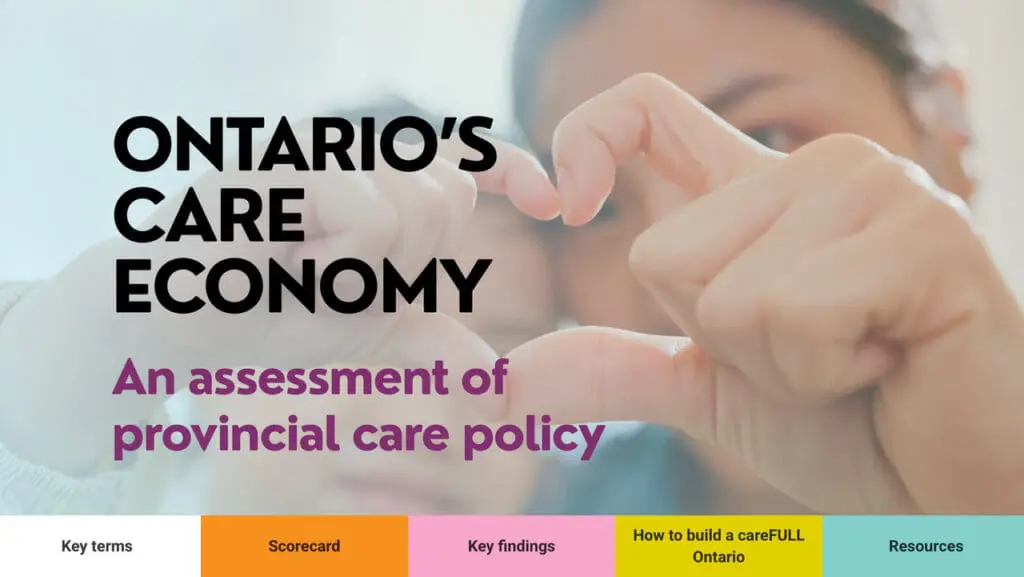
2026: Ontario’s care economy: An assessment of provincial care policy
NEW research now available!
ONN’s latest bilingual report and scorecard reveal how Ontario is faring on public policies that shape the province’s care economy.
Our care systems are currently operating at unsustainable levels, but there is an opportunity to shift policies. Explore the digital report to learn the many ways we can all work together to build a careFULL Ontario.
With the support of a three-year grant from the Department of Women and Gender Equality Canada (WAGE), we launched the Care Scorecard for Ontario at our second care economy policy summit.
The Care Policy Scorecard was launched by Oxfam in September 2021. It provides care advocates with a practical tool to measure and track government progress and commitments on policies that have a direct impact on unpaid and paid care, and provides policy makers with evidence and information to make informed decisions on these policies.
The scorecard draws on the work of feminist and development economists and the International Labour Organization’s 5R Framework to outline the key components of a care-enabling public policy environment. It includes a set of policy indicators and questions to assess progress systematically and holistically across relevant public policy areas for unpaid and paid care work. Oxfam Canada adapted the tool at the federal level but cited its limitations given most care policies are in the provincial and territorial jurisdiction. Other adaptation examples to date include: US and The Philippines.
The Scorecard consists of three sections with related policy areas:
- Unpaid care work: Policy areas related to unpaid care work, the policy measures they entail, how they address inequalities in heavy and unequal unpaid care work, and what makes them transformative.
- Paid care work: Policy areas related to paid care, the policy measures they entail, how they address vulnerable and/or unsafe working conditions and/or environments and discriminate against women and migrant care workers, and what makes them transformative.
- Cross-sectoral policy areas: Key cross-sectoral policy areas related to both unpaid and paid care work, the policy measures they entail, how they address inequalities, and what makes them transformative.
Each policy area includes sets of indicators alongside an assessment criteria to develop an overall score for each indicator. At the end of each policy area, there is a scoring matrix provided to indicate the degree to which the policies are transformative.
Building a careFULL Ontario
Everyone relies on care, and care work is central to how our economy works. While the crisis in care is urgent, it can be solved with collective action that advances policy solutions for the public good.
We invite nonprofits, workers, and their allies to advocate for a healthy care economy. Together, let’s build a careFULL Ontario.
Ontario’s care economy network
- Atkinson Fellow, Armine Yalnizyan
- Care Economies in Context, Centre for Global Social Policy
- The Care Economy Initiative
- LEAF Women’s Legal Education & Action Fund
- National labour force strategy for community services sector
- Canadian Centre for Policy Alternatives
- Canadian Labour Congress
- Oxfam Canada
- Canadian Women’s Foundation
- CUPE Ontario
- Wellesley Institute
- Caring about care workers: centring immigrant women personal support workers in Toronto’s home care sector
- The City for All Women Initiative